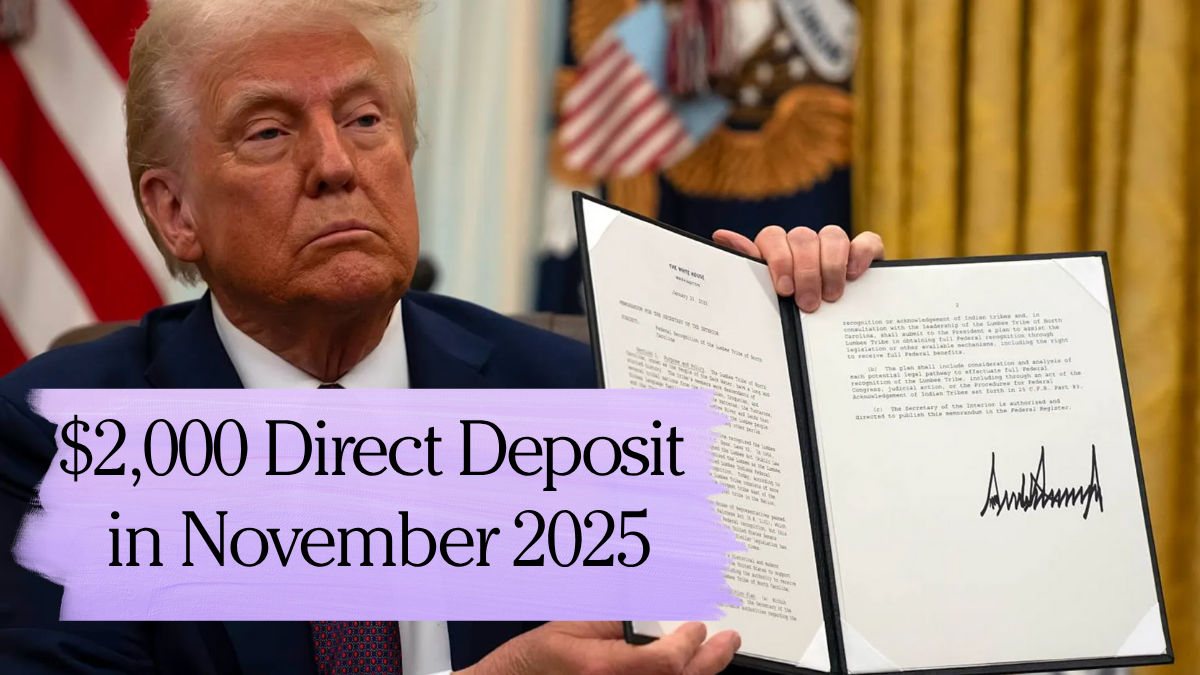
There is a recurring claim circulating on social media and some online publication sites that the Internal Revenue Service (IRS) or the U.S. government will issue a direct-deposit payment of $2,000 to U.S. citizens sometime in November 2025. Some versions of the story suggest it is part of a stimulus or relief program, potentially funded via tariff revenue or other special sources.
Below we break down the claims, what is and isn’t true, likely eligibility if it were real, what’s actually happening instead, and how to protect yourself from scams.
What People are talking About
According to several web posts:
- Eligible U.S. citizens could receive a $2,000 direct deposit in November 2025
- The payment may be part of a “tariff-funded stimulus” (i.e., using import tariff revenues rather than new federal debt).
- Some claims suggest that this payment is for all citizens, or at least for “most Americans”.
- The timeframe is sometimes given as “as early as November 2025” for the direct deposit.
What the Official Position Is
- The IRS website shows that the “Economic Impact Payments” (i.e., stimulus checks related to COVID-19) are historical content; all first, second and third rounds have been issued and this page is no longer updated for new stimulus payments. IRS
- Independent fact-checkers and financial news outlets have labelled the $2,000 payment claim as unverified and likely a rumour. For example, the article from October 16, 2025 says the claim about a $2,000 direct deposit is circulating widely, but it emphasises no official announcement has been made.
- One article summarises that while the idea of distributing tariff revenue to citizens has been floated by some political figures, there is currently no law, no official IRS program, and no formal plan in place to send a $2,000 payment.
Thus: there is no guarantee that a $2,000 direct deposit payment will happen, and if it does, the specifics (eligibility, timing, amount) are not publicly set out yet.
If It Happened — Hypothetical Eligibility & Payment Details
If the payment were to be implemented, based on past stimulus/relief programs and online speculation, the following would likely apply (but note: this is hypothetical):
Eligibility Criteria (Speculated)
- U.S. citizenship or lawful residence with Social Security number.
- Filed 2024 tax return (or in the case of earlier stimulus, something similar).
- Income threshold: past checks often paused or reduced for higher income filers; rumours suggest single filers under ~$75,000 AGI or joint filers under ~$150,000 as a possible benchmark. The Sun
- Not claimed as a dependent of someone else.
- Bank account configured for direct deposit or prior record of one.
Payment Amount / Timing
- The headline amount: ~$2,000 per eligible individual.
- Payment method: direct deposit into bank account; possibly a mailed check or debit card for those without direct deposit.
- Timing: Payment discussed for November 2025, with possibility of early deposits if direct deposit is enabled. Some sources mention “as early as November” if approved.
What would happen after approval
- The IRS (or another designated agency) would publish guidance and a portal (such as “Get My Payment” previously) to check status.
- Payments would be automatically issued (for those who meet criteria) or require minimal action from recipients.
- There would likely be a cut-off date to qualify (e.g., tax return filed by certain date, bank info registered by certain date).
What’s Actually Happening Instead
Since there is no confirmed $2,000 payment:
- Individuals should continue receiving regular benefits (e.g., Social Security, pensions, etc.) if eligible. The existence of a new broad stimulus does not replace or guarantee changes in these.
- The IRS strongly warns about believing payment-rumours and emphasizes that any legitimate payments will be announced via official channels (irs.gov, treasury.gov) and not via unsolicited emails, phone calls, or social media posts. app.com
- Taxpayers are advised to maintain up-to-date bank account details with the IRS or Social Security Administration (if applicable) to ensure correct deposit of any legitimate payments.
Risks & Scams to Watch Out For
Because rumours abound, scams often follow. Here are red flags and protective tips:
- Unsolicited communication claiming you must “pay a fee” or “verify bank info” to receive the $2,000 payment: The IRS never asks for bank routing or account numbers by phone or email to deposit stimulus checks.
- Fake websites or forms asking for personal data (SSN, identity info) saying “you’ll qualify for $2,000 in November”: Always verify via the official IRS website.
- Social-media posts encouraging you to click links or sign up for “payment registration”: Before doing so check official sources.
- Promises of “everyone will receive $2,000”: Many of these claims lack basis in law or official announcement — treat with caution.
- Protect your personal information: Never give confidential details in response to unverified claims.
Key Takeaways
- At this time there is no official, confirmed $2,000 direct deposit for U.S. citizens scheduled for November 2025.
- If such a payment were implemented, detailed eligibility criteria and payment mechanism would be announced by government agencies.
- Until then, rely on official sources (IRS.gov, Treasury.gov) for accurate information.
- Be vigilant about scams claiming the $2,000 payment — they exploit the hopes of recipients but may steal personal data or funds.
What to Do If You’re Curious / Want to Stay Prepared
- Ensure your tax filings for 2024 are up to date, and your bank account information is correct with the IRS or Social Security if applicable.
- Monitor official announcements: check IRS news releases, Treasury press statements.
- Do not pay any fees or provide sensitive personal/banking information claiming you’ll receive $2,000.
- If you believe you’re eligible for other existing benefits (e.g., Social Security, SSI), continue to focus on those programs rather than relying on a new payment.
- If you encounter suspicious communication, report it: you can contact the IRS phishing reporting system or your local consumer protection office.
Conclusion
The notion of a broad-based $2,000 direct deposit for U.S. citizens in November 2025 is currently unverified and should be treated with caution. While the idea may have political discussion behind it (e.g., tariff-funded dividends), no law has been passed and no official payment program launched. If such a payment does proceed, the government will provide the formal eligibility and payment timeline. Until then, stay informed via official sources and remain alert to scams.